
Hoppers
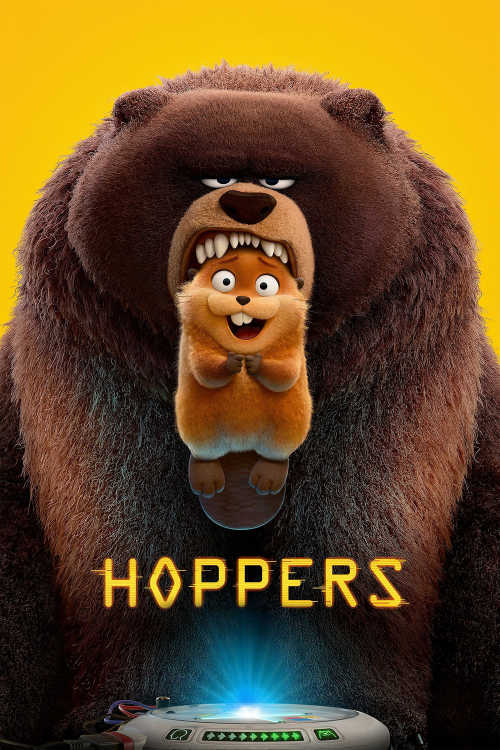
Hoppers is about a young woman, Mabel, who loves animals and nature and uses technology to inhabit an artificial beaver body, allowing her to communicate with animals and experience life as one of them. It’s a fun and heartfelt story that feels like a return to the classic Pixar formula of telling relatable, character-driven stories through a non-human lens, reminiscent of Toy Story and A Bug’s Life.
(Spoilers Ahead!)
Synopsis
Mabel uses the titular “Hopper” technology to find out why all the animals left the Beaverton Glade and coax them to return in order to stop a highway from being built over the little patch of nature she grew to love with her grandmother. She learns that the animals were driven away from the area by the mayor, who’s passionate about the highway project. The animals set up a community made of many species, and while crowded, they are able to live in relative harmony and accomplish great things through cooperation. Things go south when Mabel explains what’s happening to the glade to a council of animal leaders, and to her dismay, they decide they’re going to “squish” the mayor. Mabel and her new animal friends then pivot to trying to save the mayor’s life because, while they wanted the project stopped, they didn’t want to resort to violence. In the attempt however, the animal leaders capture Mabel and the mayor, and the insect king, Titus, steals the hopper technology and uses it to create an artificial body resembling the mayor, planning to destroy the humans of Beaverton using the same human technology that drove the animals out of the glade. Mabel and the mayor work together, along with the friendlier animals, to stop Titus and save the city.
What Works
At its heart, Hoppers is a simple story about how we are stronger when we work together instead of constantly giving in to anger and impulsiveness and fighting against each other. It presented the message in a way that was simple to understand, without feeling the need to dumb it down or overcomplicate it. It also did a good job of pointing out that it’s not always easy. Mabel and the mayor acknowledged their differences, even saying they would still oppose each other after they finished saving the city, but for that moment at least they had a common goal, and they would focus on that while they had to.
The message that there’s good in everyone and that people can change resonated with me. The mayor wasn’t some cartoonishly evil caricature of an urban developer like in so many stories. He was a little self-absorbed, short-sighted, and even unscrupulous. But he cared about his city and eventually experienced a change of heart. Yes, it took a near-death experience for him to see the error of his ways, but he did change, which isn’t something that can be said about everyone. In contrast, Titus the bug king had a chance to change his own heart and do the right thing, showing mercy to the humans rather than enacting his plan of revenge. But he chose not to. Sometimes people who’ve made poor choices decide to change, and other times they double down. The film presents this difficult reality in a simple yet effective way.
The visuals for the film were great! They reminded me of the style of Big Hero 6: clean and not overtly stylized, while still allowing every character to be visually distinct and have plenty of personality. I liked how the animals themselves looked slightly different depending on from whose perspective we were seeing them. When seen from a human’s point of view, they looked more like real animals. But when seen from the animals’ point of view, they were a bit more stylized and expressive. It worked as a subtle signal to the audience.
There were a couple of other good character-related moments that stood out to me. Mabel losing her grandmother, who taught her about the healing power of nature, strengthened her resolve without making the loss her sole focus. She already loved animals and nature. Her grandmother just made it personal. And George, the leader of the beavers, is a lovable character. I was prepared for him to be some kind of charismatic cult leader who acts nice on the outside but is secretly power hungry, but I was pleasantly surprised to find that he was genuine and not some ill-conceived twist villain. He really cared about all the animals that the humans had displaced. He was likeable and earnest without being annoying, and his sincerity was refreshing. Also, his rule “If you need to eat, then eat,” might seem dark at first, but it’s kind of funny and makes an odd amount of sense how none of the prey animals seem to take it personally, and how none of the predators take advantage of the system. Just because you eat meat doesn’t mean you have to be a jerk about it!
The story was well written. I like how each character’s actions led naturally to consequences that drove the story. Mabel’s zealousness to protect the glade led to a violent confrontation between humans and animals, which led to the fire and destruction at the climax of the film, which led to the animals and humans working together to save the city and put out the fire. I also like how the hopper technology didn’t merely serve as a MacGuffin to kick off the story. It was used throughout in ways that were internally consistent. I thought it was especially clever how they ended up using the technology as a means of interspecies communication, which further helped drive the story forward.
What Didn’t Click
I had only a few criticisms of the film. They didn’t detract too much from it, but they were some rough patches that could have been smoothed over or done a different way. For one, the scene in which Mabel accidentally squishes the insect queen was a legitimate shock; not in a “Oh, this is too violent for kids” kind of way, but in a “Wow, this completely changes the tone of the movie” kind of way. It just hit different than the matter-of-fact, law-of-nature deaths of predation. Everyone’s gotta eat, but not everyone’s gotta commit manslaughter! (Or… bug-slaughter…?) Mabel involuntarily clapped her hands together on the insect queen when she aggressively flew towards her, squishing her. Everyone in my row of the theater gasped in genuine surprise. Then all the other animals stared at her awkwardly as she slowly opened her hands to look at them, then shut them quickly, then nervously wiped them against the back wall, leaving behind visible streaks! The theater chuckled at that, but it almost felt unnatural, as if we were all thinking, “Are we really laughing at regicide now?” (Or… insecti-regicide…?) It’s okay to have death in movies for kids. But the moment didn’t know whether to be funny or serious, so it tried for both and felt strange because of it. It did get a belly-laugh out of me when Mabel later went up to Titus, who was pretending to be the human mayor at the time, and said in front of an audience, “I’m sorry I killed your mother,” to the crowd’s shock and horror. But again, it felt a little weird to be laughing at that!
During the scene when the animals are chasing after the mayor to kill him as punishment for the crimes humans had committed against animals, some seagulls dove into the water and then flew out again carrying a great white shark! It felt a little ridiculous. For whatever reason, I was on board with technology that allowed a human consciousness to be transferred into a robotic animal, but seagulls carrying a shark to drop on top of the human mayor strained credulity. But at least it gave us the line, “You will feel a slight biting sensation, followed by death!”
Finally, the film took a rather dramatic tone shift in the third act when the recently crowned insect king first began turning the hopper technology to his own means. Nothing too stark, but the change from funny and heartfelt to spooky and uncanny really stood out.
The Bottom Line
Ultimately, despite its simple message and a few tonal flaws, I really enjoyed Hoppers. It may not be a go-to favorite that I see myself returning to again and again, but I would definitely rewatch it in the future. It was fun, it was sincere, it made me laugh, and it made me smile. Though I do have to wonder which will have the bigger cultural impact: the film as a whole, or the 10-second teaser.
You know which one I’m talking about!